
Medicaid Planning Explained: How to Qualify for Benefits Without Losing Your Assets
Posted on February 8, 2026 by shieldsandboris
Long-term care is extraordinarily expensive. As Medicare generally does not cover long-term care (including nursing home care), it is imperative that your family has a proactive plan in place. Medicaid can help, but benefits are strictly means-tested. You need a strong plan in place to qualify without losing your assets. At The Elder Law Offices of Shields & Boris, Pennsylvania long-term care planning attorneys are proud to be leaders in estate planning and elder law for people and families across Western Pennsylvania.
Background: Long-Term Care is Extremely Expensive
According to data from the American Council on Aging, the average annual cost of a room in a nursing home in the Pittsburgh area of Pennsylvania is over $154,000. Even semi-private rooms carry six-figure price tags. These costs continue to rise each year and often last longer than families anticipate. A multi-year nursing home stay can rapidly exhaust retirement savings, home equity, and investment accounts. The financial reality makes advanced Medicaid planning a necessity rather than a luxury. People and families in Pennsylvania need a comprehensive long-term care plan.
Medicare Offers Limited Help (Medicaid is the Public Program)
Too many families in Western Pennsylvania mistakenly assume Medicare will pay for long-term nursing home care. In Pennsylvania, Medicare coverage is extremely limited. Medicare may cover short-term skilled nursing care following a qualifying hospital stay. However, it will only do so for a brief duration and only when strict medical criteria are met. Once that short window closes, Medicare coverage ends.
Medicaid is the public program that pays for long-term nursing home care. Medicaid also provides limited in-home and community-based services. With that being said, Medicaid operates as a means-tested benefit. Eligibility depends on income, assets, and prior financial transactions. Planning errors can result in denial of benefits or extended penalty periods.
The Challenge of Medicaid Planning (Strict Financial Eligibility Requirements)
Pennsylvania Medicaid imposes both income limits and asset limits. Countable resources generally must fall below a modest threshold, while income may need to be redirected through approved mechanisms. Certain assets receive favorable treatment, while others trigger eligibility problems. Medicaid also enforces a five-year look-back period. That means that uncompensated (or materially below market) transfers made during that period may result in a penalty that delays eligibility.
Key Point: The rules and regulations for Medicaid eligibility are complex, technical, and aggressively enforced. Informal gifting, poorly structured trusts, or last-minute transfers often cause more harm than good. Effective Medicaid planning requires a detailed understanding of Pennsylvania eligibility rules and a proactive approach. Our elder law team can help.
How to Qualify for Benefits Without Losing Your Assets in Pennsylvania
Qualifying for Medicaid while preserving assets requires proactive planning. Pennsylvania allows several planning strategies, but each must be executed correctly to avoid penalties or disqualification. Our Pennsylvania elder law attorneys can help. Here are some key points to know about qualifying for benefits without losing your assets:
- You Need to Know What is Countable: One of the most important concepts is distinguishing between countable and non-countable assets. Certain assets (such as a primary residence, certain personal belongings, and one vehicle) may be exempt under specific conditions. However, exemptions are not absolute. The treatment of a home depends on intent to return, equity limits, and the presence of a spouse or dependent.
- Married Couples Need to Understand Spousal Rights: Married couples face additional complexity when navigating Medicaid eligibility requirements. Most notably, Pennsylvania applies spousal impoverishment protections that allow the healthy spouse to retain a portion of the couple’s assets and income. The process involves calculating the Community Spouse Resource Allowance and Minimum Monthly Maintenance Needs Allowance. A top Pennsylvania elder law attorney can help.
- Income Planning Should Be Proactive: Income planning is another critical component of a Medicaid long-term care strategy. When income exceeds Medicaid limits, Pennsylvania permits the use of a properly drafted income trust, commonly referred to as a Miller Trust. The trust allows excess income to flow through a restricted account while preserving eligibility. Improper trust drafting or administration will invalidate the strategy.
- A Trust Can Protect Assets (If Set Up Early Enough): Asset protection trusts may also play a role in Medicaid planning. However, they can only truly and effectively do so when implemented well in advance. Irrevocable Medicaid asset protection trusts can remove assets from the applicant’s estate, but transfers trigger the five-year look-back period. Timing makes all the difference. A Pennsylvania asset protection lawyer can help you set up a trust that complies with Pennsylvania Medicaid rules and federal law.
- Assets Can Sometimes Be Spent Down Strategically: Strategic spend-down is another lawful approach. Medicaid does not require impoverishment. Along with other things, Medicaid long-term care applicants may convert countable assets into exempt assets through approved expenditures. Examples include home improvements, debt repayment, prepaid funeral arrangements, and certain annuities. Each transaction must comply with Medicaid valuation and actuarial requirements.
Why Trust Our Law Firm for Medicaid Planning
Medicaid planning is important. It is imperative that you have a strong, proactive plan in place. At The Elder Law Offices of Shields & Boris, we are a law firm that invests the time, resources, and attention to detail into each and every case. No matter your situation, our Pennsylvania elder law team is prepared to help you put a strategy in place to protect your assets. Your initial consultation with our Pennsylvania Medicaid planning attorney is confidential.
Contact Our Pennsylvania Medicaid Planning Lawyer Today
At The Elder Law Offices of Shields & Boris, our Pennsylvania Medicaid planning lawyer is standing by, ready to help you and your family find the best solution. If you have any questions about qualifying for Medicaid for long-term care without losing your assets, we can help. Give us a call at (724) 235-7939 or contact us online to arrange your confidential, no-obligation case review. We handle Medicaid planning throughout Western Pennsylvania.

A Guide to Alzheimer's Care
Planning for someone who has Alzheimer’s disease can be complicated. Proper planning in advance can help alleviate many frustrations as the disease progresses. The time to act is now. Learn the steps for proper planning from our eBook to ensure that things are handled according to your wishes and that you’ve taken the best steps possible to protect your loved ones and your family’s financial security.

When Someday Arrives
We wrote this book for retirees and child caregivers as a tool to allow you to stay at home as long as possible and as a guide of what to do if you or a loved one cannot stay at home. We believe every family has a legacy to protect, and it is our job to protect that legacy. The greatest risk to today’s retiree is a long-term care health crisis. Request your copy today to prepare for what the future holds.

What To Do When A Loved One Dies
Consumers and financial planners, use this book as a down-to-earth primer of estate planning and elder law! Learn about the duties, rights, and responsibilities of the executor or administrator of an estate and what you should expect from competent legal counsel when you have to probate an estate. Find tools such as a guide to help you retain competent counsel and even an estate organizer so you can organize your own affairs.
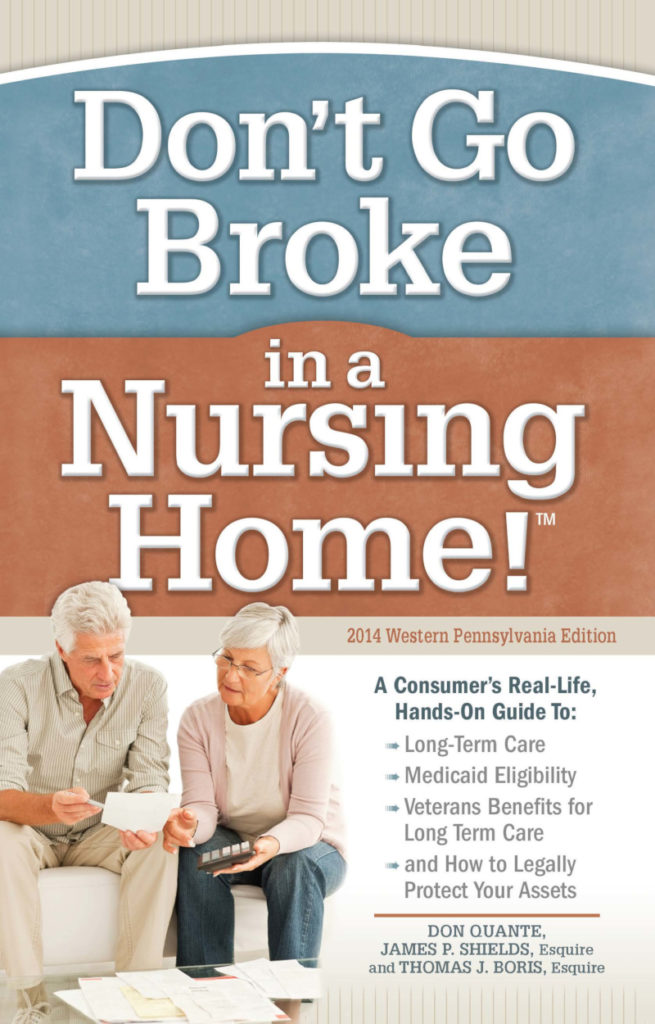
Don't Go Broke in a Nursing Home
Take back control of your life and provide excellent long-term care for your aging loved ones without going broke in the process. Find creative financial strategies to protect your assets and the quality of care you receive. In addition, learn about little-known tax incentives, how to choose the right home care providers, long-term care facilities, and how to manage the crisis.