
Retirement Planning With Healthcare Costs in Mind: Preparing for the Unexpected
Posted on August 5, 2026 by shieldsandboris
Did you know that healthcare represents nearly one-fifth of all spending in the United States? According to data from the Centers for Medicare & Medicaid Services (CMS), total healthcare spending nationwide exceeded $5 trillion in 2024. For senior citizens, the cost of healthcare is an especially important consideration. A retirement plan that does not properly consider healthcare costs may be insufficient. At The Elder Law Offices of Shields & Boris, our Pennsylvania elder law attorneys can help you with retirement planning while keeping healthcare costs in mind.
You Should Build a Healthcare Budget Around Medicare’s Actual Cost-Sharing Rules
Medicare provides critically important financial coverage to senior citizens. However, it would be a mistake to assume that Medicare will cover all of your health costs after you turn 65 years of age. The reality is far more complicated. For that reason, healthcare expenses should generally be treated as a separate retirement-planning category rather than absorbed into a general estimate for living expenses. Along with other things, retirees should account for Medicare premiums, deductibles, coinsurance, prescription drugs, supplemental coverage, dental care, vision care, hearing services, and expenses that arise when a provider or treatment is outside a plan’s network or coverage rules.
Original Medicare commonly requires beneficiaries to pay 20% of the Medicare-approved amount for Part B services after satisfying the deductible. Medigap insurance may cover some cost-sharing for Medicare-covered services, but it generally does not pay for services that Medicare itself excludes. A legally and financially sound plan should therefore distinguish between predictable premiums, variable out-of-pocket expenses, and major risks that remain uninsured.
Long-Term Care is a Separate and Potentially Substantial Risk
One of the most important distinctions in retirement planning is the difference between medical care and custodial long-term care. Medicare may cover qualifying short-term skilled nursing or rehabilitation services, but it generally does not cover ongoing assistance with activities of daily living, such as bathing, dressing, eating, or using the bathroom. A person who needs long-term custodial care may be responsible for the entire cost unless private insurance, personal assets, or Medicaid is available.
Possible funding strategies include dedicated savings, traditional long-term-care insurance, hybrid life-insurance products, home equity, family support, or eventual Medical Assistance eligibility. Pennsylvania also recognizes qualifying Long-Term Care Partnership policies. Subject to program requirements, such a policy may allow the insured to protect assets equal to benefits paid under the policy when later applying for Medicaid and may provide corresponding protection from estate recovery. The suitability of any insurance product depends on premiums, elimination periods, benefit periods, inflation protection, exclusions, and the insurer’s financial strength.
Pennsylvania Medicaid Planning Must Begin Before a Care Crisis
Pennsylvania Medical Assistance can pay for qualifying nursing-facility services and certain home- and community-based services, but eligibility is subject to medical, income, resource, residency, and transfer-of-assets rules. When a person applies for long-term-care Medicaid, the County Assistance Office reviews transfers made during the preceding 60 months. A transfer for less than fair market value can trigger a penalty period during which Medicaid will not pay for otherwise covered long-term care services.
Married applicants are also subject to spousal-impoverishment rules. These provisions allow a community spouse to retain a protected share of the couple’s countable resources and, in some circumstances, receive income from the institutionalized spouse. The applicable allowances and limits are adjusted periodically. Transfers involving a residence, retirement account, annuity, trust, jointly owned property, or a family caregiver agreement require careful analysis, as seemingly routine transactions may affect eligibility.
Note: Pennsylvania may also recover certain Medical Assistance payments from the probate estate of a recipient who received long-term-care benefits after age 55. Estate recovery is subject to statutory limitations, deferrals, exemptions, and hardship procedures, but it should be evaluated before assets are retitled or an estate plan is finalized.
Be Prepared: Retirement Withdrawals Can Increase Medicare Premiums
The order and timing of retirement-account withdrawals can affect healthcare costs. That is something that should be prepared for and considered. Medicare beneficiaries with modified adjusted gross income above applicable thresholds may owe an income-related monthly adjustment amount, or IRMAA, in addition to ordinary Part B and Part D premiums. Social Security generally calculates IRMAA using federal tax-return information from two years before the applicable premium year. Large traditional IRA withdrawals, Roth conversions, capital gains, or other taxable transactions can therefore increase Medicare premiums in a later year.
Many retirees must also take required minimum distributions from traditional retirement accounts beginning at the age prescribed by federal law. Those mandatory distributions can reduce future flexibility to control taxable income. Retirement planning may involve coordinating taxable accounts, tax-deferred accounts, Roth assets, charitable distributions, Social Security benefits, and anticipated healthcare spending.
Incapacity Documents are Part of Healthcare Financial Planning
A retirement plan may fail if no one has legal authority to manage assets or make healthcare decisions following incapacity. Under Pennsylvania law, a healthcare power of attorney can authorize an agent to make healthcare decisions that the principal could have made personally, subject to limitations stated in the document. A separate durable financial power of attorney can authorize an agent to pay insurance premiums, manage accounts, handle retirement-plan transactions, apply for benefits, and address care expenses. A Pennsylvania estate planning attorney can help you put the right overall structure in place for your specific situation.
We are Leaders in Elder Law and Retirement Planning in Pennsylvania
Healthcare is expensive, and the costs continue to rise even faster than the overall rate of inflation. A comprehensive approach to retirement planning is one that has healthcare costs in mind. At The Elder Law Offices of Shields & Boris, we are committed to helping people and families prepare for the unexpected. Your initial consultation with our Pennsylvania elder law attorney is strictly confidential and carries no additional obligations.
Contact Our Pennsylvania Elder Law Attorney Today
At The Elder Law Offices of Shields & Boris, our Pennsylvania elder law attorney is standing by, ready to protect your rights and your interests. If you have any questions about retirement planning with healthcare costs in mind, we are here to help you prepare for the unexpected. Give us a call at (724) 286-4745 or contact us online to set up a completely confidential initial consultation. We work with people and families throughout Western Pennsylvania.

A Guide to Alzheimer's Care
Planning for someone who has Alzheimer’s disease can be complicated. Proper planning in advance can help alleviate many frustrations as the disease progresses. The time to act is now. Learn the steps for proper planning from our eBook to ensure that things are handled according to your wishes and that you’ve taken the best steps possible to protect your loved ones and your family’s financial security.

When Someday Arrives (2nd Edition)
We wrote this book for retirees and child caregivers as a tool to allow you to stay at home as long as possible and as a guide of what to do if you or a loved one cannot stay at home. We believe every family has a legacy to protect, and it is our job to protect that legacy. The greatest risk to today’s retiree is a long-term care health crisis. Request your copy today to prepare for what the future holds.

What To Do When A Loved One Dies
Consumers and financial planners, use this book as a down-to-earth primer of estate planning and elder law! Learn about the duties, rights, and responsibilities of the executor or administrator of an estate and what you should expect from competent legal counsel when you have to probate an estate. Find tools such as a guide to help you retain competent counsel and even an estate organizer so you can organize your own affairs.
Download!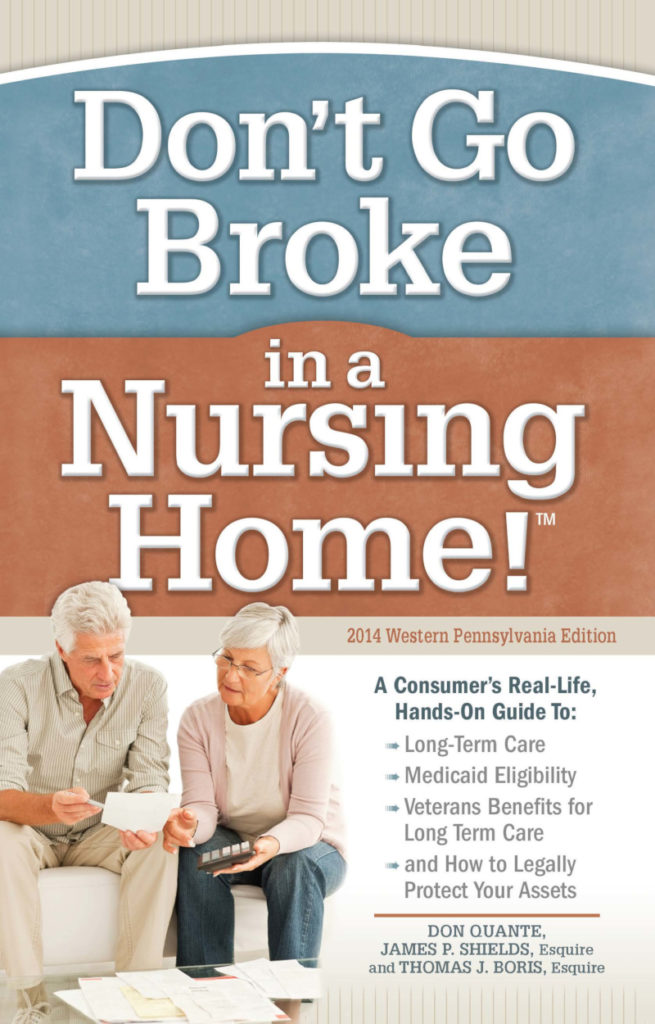
Don't Go Broke in a Nursing Home
Take back control of your life and provide excellent long-term care for your aging loved ones without going broke in the process. Find creative financial strategies to protect your assets and the quality of care you receive. In addition, learn about little-known tax incentives, how to choose the right home care providers, long-term care facilities, and how to manage the crisis.